
A cross-training effort can become little more than informal job rotation, tracked loosely in a spreadsheet, with no clear gate between “watched Dave do it once” and “certified to run the line alone.” That gap can leave a supervisor unsure who is ready for the task. A more useful program combines a reliable skills matrix with standardised work and a training pathway that checks competency as well as any required training time.
Table of Contents
Why informal rotation isn’t cross-training
Job rotation and cross-training get used interchangeably on the floor, but they’re not the same thing. Rotation moves people between stations to break monotony or cover absences. Cross-training builds verified proficiency across multiple workstations, with documentation showing that someone can do the job to standard, rather than simply confirming that they’ve stood at the station before.
The distinction matters because rotation without proficiency checks can spread inconsistent habits. If your standard work isn’t documented and assessment relies on a supervisor’s impression, you may be passing on whatever the trainer happens to do. Look at the equipment and skills your own line depends on. Where one technician holds knowledge of both mechanical and digital systems, their absence deserves attention in the plan. Cross-training should address those observed dependencies rather than begin with a general target for moving people between stations.
Start with a skills gap analysis, not a training calendar
Before you build any kind of program, walk the floor and answer a blunt question: for every critical process, how many people can actually run it to standard right now? Count them. Then identify the stations where that number is one.
Those single points of failure form your starting priority list. The goal shouldn’t be for everyone to know everything. Focus on stations where an absence, injury or resignation could stall the line. Check specialised changeover work, calibration-sensitive processes and equipment that only one veteran operator fully understands, then confirm where the actual coverage gaps are rather than assuming every plant has the same risks.
This audit also shows where cross-training doesn’t need to go. Low-risk, low-complexity auxiliary tasks don’t warrant the same investment as a tight-tolerance CNC setup or a safety-interlocked press line. Skipping this step is how facilities end up with training budgets spread thinly across forty stations instead of concentrated on the six that genuinely threaten throughput.
Hiring pressure adds to this operational risk. Cross-training won’t solve a labour shortage on its own, but it can reduce a plant’s dependence on external recruitment by developing more capability among existing employees.
Build the matrix as a living document
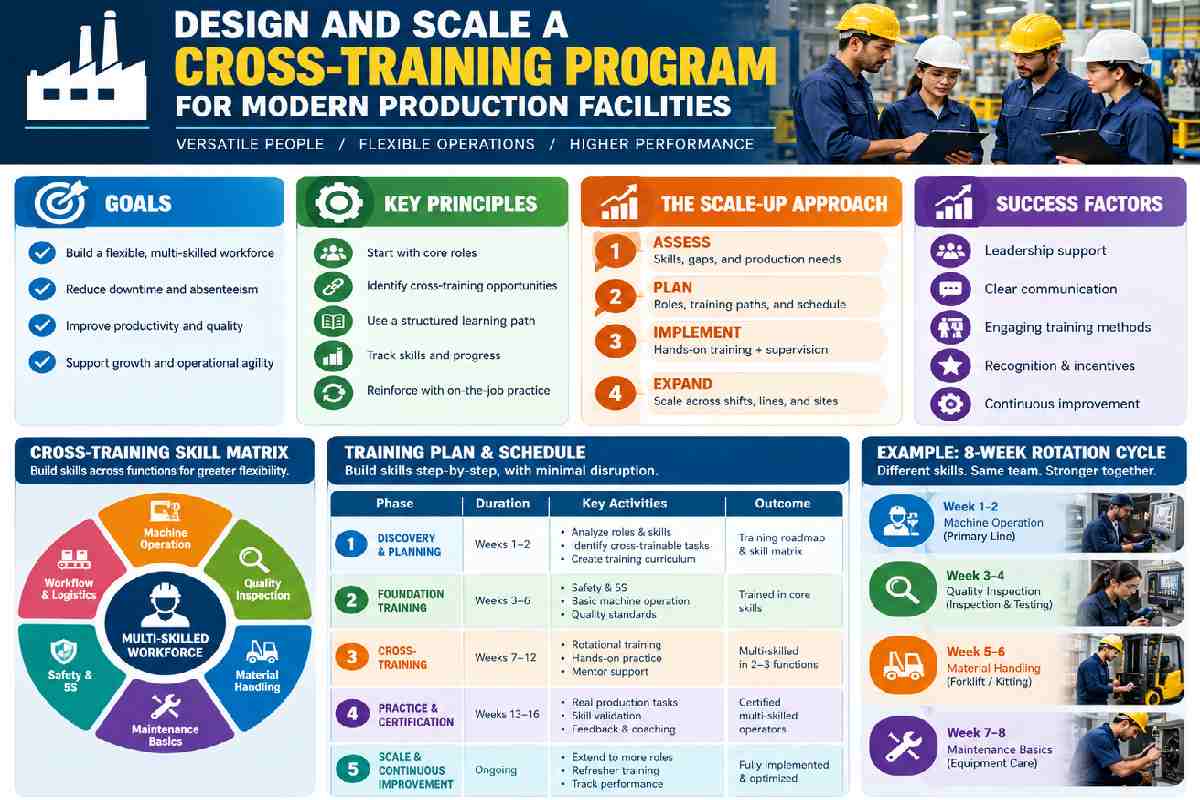
Once you know where the gaps and risks sit, the skills matrix becomes the operational record of who can do what and to what level. List every workstation or duty down one axis and every operator down the other. In each cell, record a proficiency level rather than a checkbox, using categories such as novice, supervised, certified and trainer. Attach an assessment date to every entry.
That date matters as much as the level itself. A matrix that says “certified” with no timestamp is little more than a rumour. A matrix that says “certified, assessed March 14” gives a supervisor information they can use to plan a shift.
Before building from scratch, you could use a skills matrix for the manufacturing industry as a starting point and compare it with the plant’s own tasks and assessment standards. A tight-tolerance aerospace supplier and a food packaging line may need different definitions of readiness. Check that the chosen structure can record stations, people, proficiency levels and dates without obscuring the evidence behind each entry. A template is useful only if supervisors understand what its categories mean.
Keep it as a living document instead of treating it as an annual audit exercise. Update it whenever someone completes an assessment or a certification expires, and when a new station or process is added. A matrix that’s six months out of date can be worse than no matrix because supervisors may continue to trust it.
Standardized work comes first, always
None of this works if the job itself isn’t documented. Standardised work is the actual process, written down step by step, with the tolerances, sequence and safety checks that define “correct”. If that document doesn’t exist, cross-training simply spreads whatever the most senior operator happens to do, including their personal quirks.
The same principle applies to changeover training. When several people on a shift learn the task, each should work from the same documented sequence and acceptance checks. Otherwise, a training program can spread different versions of the job and leave the next shift to resolve the inconsistency. Review the instructions with experienced operators so that the written process reflects the standard you actually expect trainees to meet.
If you’re serious about cross-training, audit your standard work before you audit your people. Fix the gaps in documentation first. The training pathway, assessments and certification decisions all depend on that foundation.
Structure the training pathway in stages
Progression should move through distinct stages, with each one gated by an assessment rather than time served:
Observation comes first, with the trainee watching the process against the documented standard rather than copying whatever the incumbent operator happens to do that day. Supervised practice follows, allowing the trainee to run the task while someone is present to catch deviations in real time. The operator can then move to unsupervised work subject to periodic audit, working independently while still receiving spot checks. Certified trainer status is the final stage and should be reserved for people who can perform the task correctly and teach it to someone else.
Gate each transition on a competency assessment, alongside any required training time. Logged hours show attendance, but don’t establish practical competence by themselves. Break the job into defined skills and have the assessor check each one rather than relying on informal shadowing. Record where further practice is needed so that the next supervisor can continue the training without guessing what the worker has already demonstrated.
Calibrate the level of rigour to the risk. A task involving safety interlocks or strict quality tolerances should require a longer supervised period, documented sign-off and a stricter pass threshold than a low-risk auxiliary task such as restocking a line. This is the part people often resist: you should not cross-train everyone on everything. Disciplined prioritisation based on the risk and criticality of each task distinguishes a program that improves flexibility from one that creates quality escapes by rushing someone through certification on a station they weren’t ready to operate.
Schedule rotations around production, not around the training plan
A cross-training schedule has to serve the line first. Stagger multi-skilling so that no single shift loses all its certified operators to training at once. If your only two certified press operators both rotate into training during the same week, you’ve recreated the single point of failure you were trying to remove.
Use flexibility deliberately to load-level around demand peaks and planned outages. If you know a maintenance shutdown is coming in Q3, that may be the right window to pull operators into cross-training on adjacent stations. The week before a volume spike probably isn’t.
Manufacturing execution systems and HR-tech platforms may help with the administration. Before changing tools, identify what is difficult to maintain manually across your shifts and stations. Test whether proposed software can flag the expiry dates you use, support reassessment scheduling and let supervisors find the underlying records. An automated reminder is helpful only when someone owns the follow-up and the dates in the system are accurate.
Measure it like a production metric, not an HR initiative
Report cross-training progress in the same reviews where you examine scrap rates and downtime, rather than placing it in a separate HR dashboard that nobody on the floor sees. Track a labour flexibility rate, meaning the share of critical stations with more than one certified operator. You can also track the number of certified operators per critical process, assessment pass rates and unplanned downtime connected to staffing gaps.
If downtime linked to absences or turnover falls after the program begins, investigate whether better coverage contributed. Check for other changes in demand, staffing or equipment before attributing the result to training. If coverage hasn’t improved, review the pathway and matrix before expanding; a rising count of certificates alone doesn’t establish that the line is more resilient.
Plan for skill decay before it becomes a problem
Proficiency fades without practice. A “certified” operator who hasn’t touched a station in fourteen months may no longer be current, regardless of what the matrix said on the day they qualified. Build a defined recertification interval into the program from day one. Set the interval according to task risk, frequency of use, process changes, manufacturer guidance and any applicable regulatory or quality requirements.
This can also be a compliance and quality-management question, not just an operational preference. Keep assessment records, approvals and supporting evidence in a form that can be reviewed when needed. Building recertification into the process from the start avoids having to reconstruct the evidence later.
Connect the matrix to career paths, not just coverage
The matrix isn’t only a coverage tool. It can also help explain a career path to an operator. Someone who can see the specific stations, assessments and certifications associated with a lead-operator role has a clearer basis for discussing development, provided those expectations match the actual role and promotion process.
Tie new certifications to skill-based pay increases or defined progression steps wherever your compensation structure allows it. A visible, matrix-backed progression path can support retention by showing employees how new capabilities connect to greater responsibility and reward. It also supports succession planning directly. The same matrix that flags current single points of failure can show who’s ready to step into a specialist or supervisory role when someone retires.
A cross-training program that survives beyond one quarter isn’t necessarily the one with the most people trained. It’s the one with a clear matrix, dependable standard work and the discipline to gate each step with a real assessment instead of a signature and a guess.